
Part 8: The Physics of Heaven
A Serial Book Review & Theological Interaction
Read Part 1: “The Physics of Heaven”
Read Part 2: “The Power of the Zero-Point Field”
Read Sidebar: “Jesus’ Lesser Works”
Read Part 3: “Extracting the Precious From the Worthless”
Read Part 4: “Vibrating in Harmony With God”
Read Part 5: BILL JOHNSON: Squandering Our Spiritual Inheritance
Read Part 6: Unsagacious Seers
Read Part 7: Bad Vibes
 |
| Advertisement retrieved Oct. 2011 from http://www.elijahshopper.com for 4 CDs “Quantum Physics, Music and the Prophetic” by David Van Koevering, Ray Hughes, Bob Jones, and JoAnn McFatter.” |
By Pastor Larry DeBruyn
Review of Chapter 6 (authored by Ray Hughes):
“Sound of Heaven, Symphony of Earth”[1]
the “Information Age,” an age of increasing revelation, prophetic
insight and sensitivity to the spirit realm…. We live in a time when
science fiction can become science fact overnight…. I believe that
the Holy Spirit has given me some pieces of the puzzle to heaven’s
sound, so the information I share with you about sound and light and
vibration will be based upon scientific fact, confessed speculation, and
spiritual revelation.
—Ray Hughes
(Emphasis added, TPOH, 65-66)
Introduction
1965 was the year when the film The Sound of Music was released. The movie’s theme song written by Oscar Hammerstein II (1895-1960), composed by Richard Rogers (1902-1979), and sung by actress Julie Andrews (1935- ), has for five decades remained a musical icon. “The hills are alive, / With the sound of music / With songs they have sung / For a thousand years,” go the song’s opening lyrics.[2] But according to Quantum Charismatics, not only are the hills alive with the sound of music, but also everything else God has infused with heaven’s “sound of many waters” (Revelation 14:2). This music, Quantum Charismatics believe, will bring revival to the church as it endows God’s “manifest sons” to interpret life even as mobilizes miraculous powers within them.
Illustration: Sight and Sound, Movie and Music
Ray Hughes illustrates how sound brings understanding to life, especially in the church. As in a motion picture, music provides meaning and creates feelings for what is seen. He refers to a movie portraying a nattily dressed woman walking hurriedly down a sidewalk on a crowded city street. Various types of accompanying music might offer different interpretations of the woman’s situation. Is the accompanying music depressing? If so, viewers could be impressed that the woman is in some kind of trouble. Is the music upbeat? Viewers would conclude she’s not in danger, but only taking a daily exercise walk. Is music romantic? Viewers might interpret that she is hustling to meet her boyfriend at Starbucks. Hughes’ point is that sound “can create a story from dry facts. It [sound] causes our emotions to go beyond facts to feelings.”[3](TPOH, 69) In Hughes’ view, sound gives meaning to sight.
“Quantum Charismatics”
So music or sound becomes a key for interpreting the experience of life in the church. Music, says the author, impacts prayer, faith and activity in the church.(TPOH, 69) Sound can enhance if not determine spirituality. Reverbs can create revival. To this point, Hughes informs readers that, “With every revival, there has been a release of new music or sound.”(TPOH, 69) He then goes so far as to suggest that, “Whether the music releases the revival, or whether the revival releases the music varies from generation to generation.”(TPOH, 69) Hughes compares the issue to be like asking the old question of what comes first, the chicken (the revival) or the egg (the music). The right music creates the atmosphere of worship and facilitates a working of signs and wonders. This theory of sound or music—primordially infused by God into nature’s elements—drives, as Hughes states, the Quantum Charismatic view of spiritual life. We turn to summarize and look at the theory the author espouses.
 |
| Ray Hughes’ quantum music advertised on TheElijahList, 6/19/07 |
The Author’s Theory:[4]
God is light/sound (“Although light and sound are located on different frequencies, they are the same thing.”(TPOH, 66) When God said, “Let there be light,” He “released” and infused His sound-music into three of the four elements which ancients believed comprised the universe—water, wind and fire. The three elements began to Quantumly vibrate with heaven’s music, “the sound of many waters.” But nature’s fourth element, earth, was lifeless until… God took earth/dirt, made Adam and animated him with sound/soul. The first sound Adam ever heard was God breathing His music into him. Because humans have sound/soul—unlike wind, fire and water which possess sound only—they possess a will. So with their will/soul, humans can choose to align themselves with the music of heaven to connect with the “creative ability [power] to release the sound of God” (e.g. to perform miraculous signs and wonders). The coming of the second Pentecost will “light-up” and amp-up Charismatics with “creative ability” to do greater miracles than they’re doing today.
Music: Invoking the “Presence”
According to the author’s theory, the sound of music indicates, even dictates, God’s presence in the church, a presence that will be manifested in the “experience” of worship and the doing of “wonders.” “Anyway you look at it,” writes Hughes, “God unveils new songs and new sounds in relationship to the new revelation of His presence in His people.”(TPOH, 70) Music becomes the force stimulating revival among God’s people. New revelations inspire the invention of new sounds to be accompanied by a writing of new songs. Worship leaders calculate that the novel music will gin up fleshly emotions within the bodies and souls of excited worshippers which they believe indicate God’s presence among them.[5] Other indicators of “The Presence” include inspired prophets uttering novel revelations and empowered apostles working greater and greater signs and wonders. All of this writes the author, is based upon science (sci-fi which has become science fact), speculation and new revelation.(TPOH, 66)
 |
| Hughes’ conference advertised on TheElijahList, 1/4/08, with the stated purpose: “We plan to go into uncharted territory. We will embark on a journey to explore the mystery of color, light and sound. This road has been traversed by scientists and mystics alike. This conference will blend science, creation and theology, and is designed to release divine creative destiny.” |
Myth
From these “sources” Hughes testifies, “I believe that the Holy Spirit has given me some of the pieces of the puzzle to heaven’s sound.” (TPOH, 65) We now turn to evaluate the bases out of which the author constructs his mythical view of spiritual reality by a synthesizing of science (sci-fi and sci-fact), speculation and revelation, the first being…
First Source: Fascination (Sci-fi and Sci-fact)
Science derives from the Latin word scientia which means “knowing.” By “knowing” it can be meant that through use of the five senses which contribute to one’s consciousness (i.e., mental faculties of perception, comprehension, understanding and believing), persons may come to a personal awareness, conviction or conclusion about their environment, about what is either real or unreal, immanent or transcendent or physical or metaphysical in their conscious existence. According to Hughes, what is unreal today (imaginings called science fiction) can become real tomorrow (inventions utilizing science fact). The author premises that “we live in a time where science fiction can become science fact overnight.”(TPOH, 65) True. Within certain boundaries, this can happen. At one time for example, humans dreamed of flying like birds. They even imagined going to the moon. Those imaginings, along with many others, have become facts. But when humans imagine that they might become gods, little gods, or “manifest sons of god”—when they can’t—then their belief is an idolatrous fiction. (See Isaiah 44:8.) Admittedly Sci-Fi is a fantasy which may inspire scientific discovery, but it is fiction nonetheless, —“An imaginative creation or pretense… A lie.”[6]
Warning
The Bible warns Christians that fascination with “the elementary principles of the world” (e.g. the ancient elements of earth, wind, fire, water, and perhaps the realm of the spirits or the Aether) will draw them away from Christ in whom “all the fullness of Deity dwells in bodily form” (Colossians 2:8-9).[7] As he invests the elements, as well as the spirit realm, with “the sound of music,” this is exactly the error Hughes embraces as he promotes his quasi-Christian theory of quantum origins. About entertaining such error Paul tells his young co-worker,
avoiding profane
and vain babblings,
and oppositions of science falsely so called:
Which
some professing have erred concerning the faith.
Emphasis added, 1
Timothy 6:20-21, KJV
Second Source: Speculation
The Bible indicts the idolatrous nature of speculation(s). Scripture prohibits a speculative approach to understanding God and spirituality. Yet despite the biblical censure of it, Ray Hughes admits the information he will share about “the puzzle to heaven’s sound… will be based on… confessed speculation….”(TPOH, 65-66). In other words, the puzzle he claims to put together about the way inter-dimensional sound (heaven to earth, and earth to heaven) determines true spirituality is speculative. Speculation can mean, “To meditate on a given subject” or “to engage in buying or selling of a commodity with an element of risk.”[8] The former sense of the meaning of speculation—to meditate on a given subject—appears to be the sense in which the author employs the word, though his speculations could prove to be quite “risky” as regards the Christian faith, for imagination spawns idolatry.
 |
| Ray Hughes featured at the Quantum Leap-2 conference along with Chuck Missler, David van Koevering and JoAnn McFatter. Read Jackie Alnor’s 6/19/07 report titled Quantum Alchemy |
Creation Speculation
For example, Hughes speculates about the origin of sound in man and the decisional significance of it. “Imagine the first sound Adam ever heard was God breathing the wind or the breath of His Spirit,” he writes.(TPOH, 67) However, I am not aware that Adam possessed consciousness (something Hughes imagines he did) before “the Lord God… breathed into his nostrils the breath of life; and man became a living being” (Genesis 2:7). Hughes then goes on to assert that God gave Adam and other human beings free will to either accept or reject “His sound breathing in us.”(TPOH, 67) Did a pre-existent Adam really have the consciousness to hear God breathing His music into him and possess the freedom of will to either reject or accept it? This myth teaches that the creature possesses the independence and authority to thwart the will of the Creator. Yet despite the irony of his ontological confusion, Hughes states: “God desires to release a sound that our personal issues cannot resist.”(TPOH, 75) Of this view of God it can only be said the He “desires” but does not “determine.” (See Job 14:1-6; Daniel 9:24-27.)
Some Warnings
In describing the devolution into paganism, the Apostle Paul wrote to the Romans that “though [pagans once] knew God, they did not honor Him as God or give thanks, but they became futile in their speculations, and their foolish heart was darkened. Professing to be wise, they became fools” (Emphasis added, Romans 1:21-22). The word “speculations” (Greek, dialogismos) is variously translated as “imaginations” (KJV), “thoughts” (NKJV), “thinking” (NRSV) and “reasonings” (ASV). What’s evident in this verse’s teaching is that speculating about God does not lead a person to God, but away from Him. The place to begin one’s search for God is not from inferences based upon sci-fi or sci-fact, but in God’s revelation, to be sure His revelation of himself in nature, but also necessarily confirmed by Scripture and Jesus Christ.
The Apostle also wrote of a key mindset in which spiritual warfare is to be conducted. In waging that war, the Apostle writes that, “We are destroying speculations (Greek, logismos) and every lofty thing raised up against the knowledge [science] of God, and we are taking every thought captive to the obedience of Christ” (Emphasis added, 2 Corinthians 10:5). Furthermore, Paul told Timothy while he ministered at Ephesus to “instruct certain men not to teach strange doctrines, nor to pay attention to myths and endless genealogies, which give rise to mere speculation rather than furthering the administration of God which is by faith” (1 Timothy 1:4). Then again the elder exhorts the younger, “But refuse foolish and ignorant speculations, knowing that they produce quarrels” (2 Timothy 2:23). The point is clear. Speculation disconnects imaginers from the genuine Christian faith (Jude 3). Yet to validate his epistemological gimmicks for promoting his view of spirituality sourced in sound, the author informs readers that he has received revelations that confirm his speculations!
 |
| Ray Hughes’ conference advertised on TheElijahList, 1/15/13, that states, “It is our goal to help each other grow and release the sound of Heaven in each of our own communities.” |
Third Source: Revelation
To support the myth connecting sound with spirituality, the author also depends upon personal revelation in addition to the Bible. Listed below are some statements he made indicating his dependence upon this source (emphases added):
- We live in the “Information Age,” an age of increasing revelation, prophetic insight and sensitivity to the spirit realm….(TPOH, 65)
- I believe that the Holy Spirit has given to me some of the pieces of the puzzle to heaven’s sound….(TPOH, 65)
- The revelation that comes to the seer has everything to do with the sound of the scene being viewed. . . . The sound being heard has everything to do with how the seers will interpret what goes on.(TPOH, 69)
- God unveils new songs and new sounds in relationship to the new revelation of His presence to His people.(TPOH, 70)
To buttress his revelation, the author window dresses his speculations with Scripture references. For example, as he conjectures about how “sound” relates to the Christian’s union with Christ—“Christ in you, the hope of glory”—he theorizes; first, that the word “‘glory’ means ‘lightified’… the hope of being ‘lit,’ or the hope of being ‘sounded’”; second, that the indwelling Christ is awaiting the moment when our sound will gloriously coalesce with His; and finally, that as His instruments, we will be played in a unified and deafening crescendo of praise to God. (See Colossians 1:27.) In short, we will be as New Age Religion puts it, “illuminated.” So as is true of most false teaching, truth and error are mixed (i.e., the word “glory” might be described as “lightified,” but not for the purpose Hughes proposes).
“I heard it from the Lord of Hosts”
Yet as he theorizes about “the pieces of the puzzle to heaven’s sound,” which he claims the Holy Spirit gave him to share, Hughes abruptly inserts a quotation: “Then it was revealed in my hearing by the Lord of hosts.”(Quote marks his, TPOH, 74) Seemingly, the quotation marks indicate the statement to have been a revelation from God. So Hughes authenticates his spin on the meaning of Paul’s words regarding the indwelling Christ by stating that “it was revealed in my hearing by the Lord of hosts.” As a prophet, Hughes becomes his own authoritative reference, and readers are therefore to believe what he says comes from God. All of this sounds fantastic and as such, who of us would dare question the scenario of praise and worship Hughes creates? There’s but one problem: that’s not what Paul meant when he told the Colossians that Christ “in” them was their “hope of glory.”
 |
| Thunder School conference advertised on TheElijahList, 7/27/09. Speakers included Lou Engle, Bob Jones, Rick Joyner, Dr. Michael Brown, and Ray Hughes. An endorsement by James Ryle stated in part: “The Sons of Thunder is a prophetic promise from Heaven about a day when an army of worshiping warriors would be released….” Read: “James Ryle’s Vineyard Theology.” |
Fourth Source: Spiritism?
The author says we live in an “Information Age,” a time not only of “increasing revelation [and] prophetic insight,” but also increasing “sensitivity to the spirit realm.”(TPOH, 65) This realm of active spirits consists of both angels and demons, or principalities and powers as the Apostle Paul wrote (Ephesians 6:12). That this age, given the occult alternative existing throughout all human history, is more sensitive to the “spirit realm” is the author’s parochial and culturally conditioned opinion. Spirit worship inundated ancient civilizations. The Gospels portray Jesus constantly exorcising demons which were active among the Jews (Matthew 12:43-45; etc.). The spirituality of the Medieval Age was thoroughly wedded to a magical worldview of witches and warlocks. Try telling Voodoo worshipers in Haiti, animists in primitive cultures, or devotees of other religions that they are becoming increasingly sensitive to the spirit realm.[9] They have always been sensitive to that realm! Ever hear of the Exorcist movies dating from the 1970s? Books recording experiences with angels are numerous, as are publications dealing with demons and territorial spirits. Since the fall of Adam, the diabolical has always been present among the world’s peoples. In relation to these ever present phenomena, the author’s use of the term “white noise” (WN) must be questioned.(TPOH, 71)
WN is a variegated and complicated category of sound. Within the sound spectrum, it refers to “Acoustical or electrical noise in which the intensity is the same at all frequencies within a given band.”[10] In popular parlance, WN can refer to random talk without meaningful or decipherable content. It’s called “white” because it lacks the distinctions of color, and noise because of the difficulty in deciphering it.
In physics the subject of white noise can also become speculative. Theoretical questions arise about WN. From whence or from “whom” does it originate? Or, what might it communicate? Nobody seems to know. It just appears to be “there.” Though mathematicians attempt to calculate and understand it, in the end WN is non-rational and that being the case, people find “connection” with it at the emotional level (i.e., personal experience), whether the hearer senses the sound of it to be earthly or ethereal, weird or wonderful. Because of the non-rational character of it and the feelings it produces, white noise is mystical. As Hughes states, “Sound… causes our emotions to go beyond the facts to feelings.”(TPOH, 69) Furthermore, the human ear can hear only a fraction of the music in the sound spectrum, even less so for us who suffer from hearing loss!(TPOH, 71-72)
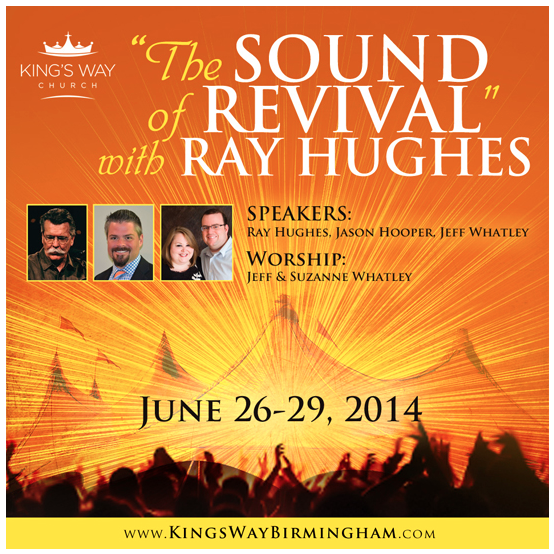 |
| TheElijahList ad, 5/11/14, that declares, “We have stepped into a NEW day and with this NEW day is coming not only a NEW Sound,” a “Sound” that “prepared the way of the Lord and in many ways prophesied into what Heaven was releasing into the earth…. so that when we hear His sound we begin to give that Sound our voice bringing an uncompromising agreement and alignment between Heaven & Earth as we look ever toward the horizon of this New Day Dawning….” |
As such, not only are certain sounds music ultimately mystical, but can also become addictively manipulative, something worship leaders of mega-churches are aware of.[11] They capitalize on the emotional “wants/needs” of the audience. The common experience of music creates a counterfeit unity and feelings of revival among worshippers as they revel around the same sound.
But there’s a darker aspect associated with the sound of white noise. Speculation about indistinct sounds that are just there introduces people to the possibility of another realm of reality, to not only what’s going on “down here” (Remember Hughes’ movie illustration?), but also to what’s going on “out there,” what Hughes calls, “increasing . . . sensitivity to the spirit realm.”(TPOH, 65)
The term WN “refers to electronic voice phenomena (EVP), where voices, which some believe to be from the ‘other side’, can be heard on audio recordings.”[12] In 2005 Hollywood produced the move White Noise. The plot is summarized as follows:
Successful architect Jonathan Rivers’ peaceful existence is shattered by the unexplained disappearance and death of his wife, Anna. Jonathan is eventually contacted by a man, who claims to be receiving messages from Anna through EVP (Electronic Voice Phenomenon). At first skeptical, Jonathan then becomes convinced of the messages’ validity, and is soon obsessed with trying to contact her on his own. His further explorations into EVP and the accompanying supernatural messages unwittingly open a door to another world, allowing something uninvited into his life.[13]
Though sound may be spiritual, but it can also be diabolical. The devil and demons can pervert the sound of music to their own praise thereby duping God’s people into thinking that what they believe is the spiritual and agape worship of God is in reality a sensual and erotic worship that not only pleases their flesh, but also adulates evil spirits and Satan! (Remember: Such misplaced worship even a good angel forbade John to do—Revelation 19:10.) The “star of the morning” (interesting that the name Lucifer means “light bearing”; he was “lightified”) was thrown out of Heaven along with the “pomp and music of [his] harps” (Isaiah 14:11; Compare 2 Corinthians 11:14.). Interesting that the manifest son of the morning’s music did not signal revival in heaven, but rebellion! So much for “white”—or should it be said?—“dark noise.”
 |
| Another Thunder School event similarly advertised 6/29/2010 on TheElijahList. On 8/2/10 the ad text included the statement: “God is calling us to bring His worship, His sounds and His colors to the streets!” |
Explaining the Glory
The many words translated “glory” in the Bible possess a complex of interrelated meanings the most common of which associated with great authority (e.g. being a political or social “heavy weight”—Hebrew kabodh meaning “weight”) or brilliant light (i.e., Greek doxa meaning “brightness”). In his second letter, Peter uses the word glory to describe what happened to Jesus at His Transfiguration (Compare 2 Peter 1:16-18 and Matthew 17:1-8). Matthew describes the event as follows:
and His face shone like the sun,
and His garments became as white as light.
Emphasis added, Matthew 17:2.
Then Peter employs the word glory and hearing the authoritative voice of God to describe the sight:
such an
utterance as this was made to Him by the Majestic Glory (doxa),
“This
is My beloved Son with whom I am well-pleased”
—and we ourselves heard
this utterance made from
heaven when we were with Him on the holy
mountain.
Emphasis added, 2 Peter 1:17-18.
From comparing these two passages, it can be seen that “glory” takes on a meaning of brilliant light. When Jesus comes again He will do so “with power and great glory” (Matthew 24:30). Thus, the hope of believers is that when Jesus comes they will experience transfiguration to appear like Him. The Christ in us will suddenly be revealed through us. Then the world will know we belong to Christ, and we to Him. This is the hope of glory. The Holy Spirit’s wondrous residence within is a down payment assuring us that when Christ does come we will before a watching world be evidentially transformed to be like Him. After being brought before the Council to defend himself against the charge of blasphemy (Acts 6:8-12), and as he began his defense, Luke informs readers that as members of the Sanhedrin looked intently at him, they saw Stephen’s face transformed “like the face of an angel” (Acts 6:15). later in the same letter when he wrote, “When Christ, who is our life, is revealed, then you also will be revealed with Him in glory” (Colossians 3:4). W.H. Griffith-Thomas (1861-1924) explained: “The presence of Christ in the heart is both pledge and fortaste of the glory which will be ours at His coming.”[14]
Myth and Consequences
Sound here, sound there, everywhere a sound, sound! The myth Ray Hughes creates about sound (i.e., “the pieces of the puzzle to heaven’s sound” which the Holy Spirit revealed to him) presents a panentheistic concept of God, that divine sound permeates the whole of nature therefore “sacredizing” everything. This becomes evident in the speculations he makes and the revelations he has been given (or so he claims). We follow two strains of his argument indicating this.
As Above, So Below
Contra Jesus, Hughes unites the world above (God’s reality) and the world below (our reality) with sound being the common and permeating denominator of the whole. This is indicated by his statement that, “Everything that God has ever brought forth has come from His creative voice—the same voice which impregnates the earth with light, sound, music, glory, the elements of God.”(TPOH, 66) Based upon this premise he therefore postulates that, “We are continually in the presence of ultrasonic [waves of sound “above” our threshold of hearing] and subsonic [waves of sound “beneath” our threshold of hearing] sound waves.”(TPOH, 68) He argues that just because we can’t see or hear the sound (kind of like sensing God’s omnipresence) does not mean it’s not there. This view of reality—as above, so below—is called Hermeticism.
Hermeticism
Hermeticism is a monistic belief that the universe’s reality is one, and that this singular reality shares a common thread of divinity. In his book Hegel and the Hermetic Tradition, Glenn Alexander Magee explains that Hermeticism understands that,
everything in the cosmos is internally related, bound up with everything else…. Divine powers understood variously as “energy” or “light” pervade the whole. This principle is most clearly expressed in the so-called Emerald Tablet of Hermes Trismegistus, which begins with the famous lines “As above, so below.” This maxim became the central tenet of Western occultism….[15]
In other words, as Hughes and other Quantum Charismatics propose, the same sound-light-power(s) permeates the whole of everything which exists with the result that they do not believe there’s a division between heaven above and earth below. All reality, the entire of whatever is, is a gargantuan seamless “One.” God has infused His power and His presence into everything which exists. Whatever is down here is also equally up there. As above, so below…
 |
| TheElijahList ad, 8/17/11, tying music to the Tabernacle of David heresy (see links at the bottom of this article). This ad credits Ray Hughes for discovering the harpist’s “spirit changing level of higher bandwidth and God consciousness.” |
Sidebar:
Quantum Charismatics are not the only ones promoting Hermetic-Gnostic philosophy in the pan-evangelical church. In The Message, we note Eugene Peterson[16] employs the phrase where the Lord’s Prayer reads, “Our Father in heaven, / Reveal who you are. / Set the world right; / Do what’s best—as above, so below.”[17] (See Matthew 6:10.) To this point, it can be noted that “paraphraser” Peterson makes Ephesians 4:6 read:
You have… one God and Father of all, who… is present in all. Everything you are and think is permeated with Oneness.[18]
Of course, one need only read Jesus’ plain words to realize that the idea of “one-ness” contradicts the “two-ness” which He declared reality to be. Jesus told the Jews:
you are of this world, I am not of this world.
I said therefore to you, that you shall die in your sins;
for unless
you believe that I am He, you shall die in your sins.”
(Emphasis added,
John 8:23-24)
With His words, Jesus declared that He and the Jews “emerge from two entirely antithetical realms,”[19] and that, “An abyss separates them from Him.”[20] Eternal heaven and temporal earth are two separate realities. This worldview contrasts to Liberal-Emergent and Quantum-Charismatic spiritualities which hold that the entire of reality—time and eternity, heaven and hell, light and darkness—is one. According to Jesus the sum of reality is not one. To believe so obliterates the distinctiveness of the Christian faith—that the eternal God is holy and separate from His temporal creation, that good and evil are opposite moral categories (There is sin.), that heaven and hell separately exist, and that Jesus came from a reality eternally separate from earth.

Cosmic Creatures: “Inner Light”
That God’s sound-light (Hughes views sound and light as identical) permeates everything, it’s necessary for light to have been in, with and around man from time immemorial. Twice Hughes proposes this to have been the case.
- With our hope of glory—Christ dwelling in us—we produce a sound that’s been with us from the beginning of time.(Emphasis added, TPOH, 74)
- Christ is your hope of producing the sound that has resided in you since the beginning of time.(Emphasis added, TPOH, 74)
Of course, this estimate raises all kinds of issues and begs all kinds of questions regarding the biblical faith and worldview. Was there really a fall when light was lost? Being dead in trespasses and sins, do unregenerate-unsaved people walk in darkness? Or has God’s sound-light (a divinity) been and continue to be in them from the beginning of time? Did the world really reside in darkness when Jesus entered it? After all, the Apostle John wrote of Jesus: “In Him was life, and the life was the Light of men. The Light shines in the darkness, and the darkness did not [overcome] it” (John 1:4-5). Assuming that from the beginning humans have been and are indwelt by the sound-light of God, do they really possess a capacity to love darkness? If they are constituted of light, why would they have to come to the Light? After all, they already think they’re light. Yet Jesus warned Jews, “Take heed therefore that the light which is in thee be not darkness” (Luke 11:35, KJV).[21] Given that light and darkness are incompatible antagonists caused John to give the following assessment of Jesus’ mission:
and men
loved the darkness rather than the Light,
for their deeds were evil.
For
everyone who does evil hates the Light,
and does not come to the Light
for fear that his deeds will be exposed.
(John 3:19-20)
The myth created by Hughes’ imagination, speculation and revelation wrecks havoc upon Scripture’s otherwise plain meaning and the good theology which derives there from even as his scenario introduces relativity into the nature of God and begs questions about the literalness of the biblical account of creation, man’s fall into sin and God’s plan of redemption.
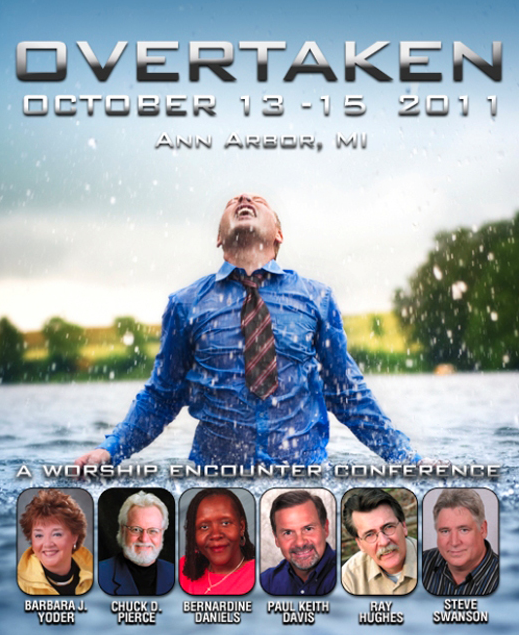 |
| Ray Hughes at a “Worship Encounter Conference” advertised on TheElijahList, 9/9/11. |
Conclusion
Christian believers ought to be aware of and appreciate deeply the truth of their union with the Lord Jesus Christ; that positionally, they are in Christ (Romans 16:3, 7, 8, 9, 10, 11, 12, 13), and that experientially, the Spirit of Christ lives in them (Galatians 2:20; Romans 8:10-11). [22] Appropriated and experienced by faith, this union—exhibited by the fruit and filling of the Spirit (Galatians 5:22-25; Ephesians 5:18-6:9)—remains an unrevealed mystery. For the time being, our lives are “hidden with Christ in God” (Colossians 3:3). But when Jesus comes again, that will change. Our lives will no longer be hidden with Christ, but exhibited with Him. When “Christ, who is our life, is revealed,” then we too will be “revealed with Him in glory” (Colossians 3:4; See Philippians 3:20-21). When that revealing will take place, God will offer empirical proof of every believer’s identity in Christ to the world, and it will not be a matter of sound, but sight! At that moment every Christian from Pentecost will glow with the glory of the Lord Jesus Christ when they are raptured-resurrected by Him (Matthew 13:43; Compare Daniel 12:3.).
The myth Ray Hughes creates via the imaginations he conceives, the speculations he engages and revelations he receives, diminishes the New Testament’s expectation regarding the Second Coming of Christ. Instead of looking for the Son, Hughes encourages readers to listen for “the sound.” Yet regarding the report he heard of the conversion of the Thessalonians, the Apostle Paul marveled “the word of the Lord [had] sounded forth from [them]” (Emphasis added, 1 Thessalonians 1:8) as they had “turned to God from idols to serve a living and true God” (1 Thessalonians 1:9). But as “the word of the Lord sounded forth from them” the Thessalonians were waiting for the coming of God’s “Son from heaven” (1 Thessalonians 1:10). These early believers were not waiting to hear the sound announcing a second Pentecost, but the sight of the coming of the Son accompanied with “a shout, with the voice of the archangel and with the trumpet of God” (1 Thessalonians 4:16). With all the Charismatic emphasis upon the myth of a coming second Pentecost and the revival created by the new music, what becomes lost is the plain teaching about Jesus’ Second Coming (not a second Pentecost).
The Charismatic expectation to be “lightified” (as stimulated by the sound of music) by the indwelling Christ has replaced the expectation of His coming physical presence from above. As a result, the hope of Jesus’ return and believers being glorified with Him becomes unnecessary. Until He comes again, we need to “watch out that the light in you is not darkness” (Luke 11:35).
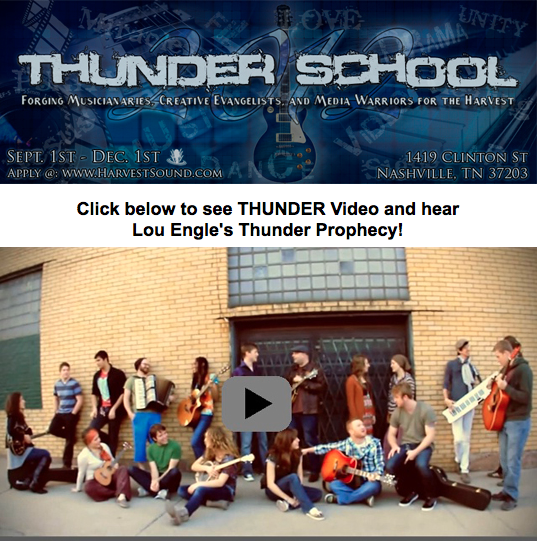 |
| The 5th Thunder School advertised on TheElijahList, 4/18/12. This ad links to Lou Engle’s “prophecy” https://www.youtube.com/watch?v=1jK3LgsvHOs&feature=uploademail, which is a re-hash of an old Latter Rain cult prophecy about music that would be more powerful than the Beatles and fill stadiums with New Breed youth. Read: “The Significance of Youth-Filled Stadiums” |
Endnotes
[1] Ray Hughes, Chapter 7: “Sound of Heaven, Symphony of Earth,” The Physics of Heaven: Exploring God’s Mysteries of Sound, Light, Energy, Vibrations and Quantum Physics, by Judy Franklin & Ellyn Davis (Crossville, TN: Double Portion Publishing, 2012): 65-75.
[2] Julie Andrews, “The Hills are Alive” from “The Sound of Music,” (http://www.lyricsmania.com/the_hills_are_alive_lyrics_julie_andrews.html).
[3] About this Hughes is correct and that’s why for many, music has become the interpreter of the faith. If it makes me feel good I will believe it! The problem with this anthropocentric approach to both truth and spirituality is that the Bible is not a music machine. The Bible is the Logos, not the Eros, of God, and the Holy Spirit the accompaniment! (See 1 Corinthians 2:6-16.)
[4] To support the scenario he creates, the texts Ray Hughes uses are: 1 John 1:5, “God is light”; Genesis 1:3, “Then God said, ‘Let there be light’; and there was light”; and Revelation 14:2, “And I heard a voice from heaven, like the sound of many waters and like the sound of loud thunder….”
[5] See Larry DeBruyn, “Getting ‘High’ on God: Inner Opiates and the Genius of the Megachurch ‘Experience’,” Guarding His Flock Ministries, September 6, 2012 (http://guardinghisflock.com/2012/09/06/getting-high-on-god/#more-2212).
[6] Webster’s II: New College Dictionary (Boston, MA: Houghton Mifflin Company, 1995): 416.
[7] Larry DeBruyn, “The Supreme Supremacy of the Lord Jesus Christ: Christ before Cosmos,” Guarding His Flock Ministries, August 13, 2013 (http://guardinghisflock.com/2013/08/13/the-supreme-supremacy-of-the-lord-jesus-christ/#more-2442).
[8] Webster’s II: 1060.
[9] During the Northern Chinese Famine of 1876-1879 when it is estimated that 9-13 million people died, “crowds flocked to the temples to entreat the Higher Powers. Theatricals were staged, to propitiate hard-hearted gods, whose images were carried out into the open street and respectfully enthroned where the best view could be obtained of the stage. Processions were daily made to wayside altars and city shrines, led by Taoist devil-worshippers, frantic with excitement, or mediums under the influence of spirit-possession.” See Mrs. Howard Taylor, Pastor Hsi: Confucian Scholar and Christian (London, GB: China Inland Mission, First Published 1900): 21-22. Testimonies of experiences of sights like this, historical and contemporary, can be multiplied.
[10] Webster’s II: 1260.
[11] DeBruyn, “Getting ‘High’ on God.”
[12] “White Noise (film),” Wikipedia: the Free Encyclopedia (http://en.wikipedia.org/wiki/White_Noise_%28film%29).
[13] “WHITE NOISE (2005),” Rotten Tomatoes: Movie Info (http://www.rottentomatoes.com/m/white_noise/#).
[14] W.H. Griffith Thomas, Studies in Colossians and Philemon (Grand Rapids, MI: Baker Book House, 1973): 66. Likewise, Harris writes that, “the indwelling of the exalted Christ in individual believers is their assurance of coming glory.” See Murray J. Harris, Colossians & Philemon: Exegetical Guide to the Greek New Testament (Grand Rapids, MI: William B. Eerdmans Publishing Company, 1991): 72.
[15] Glenn Alexander Magee, Hegel and the Hermetic Tradition (Ithaca: Cornell University Press, 2001): 13.
[16] See Larry DeBruyn, “‘Deliteralizing’ the Bible, from Plato to Peterson: Scripture amidst the Shadows,” Guarding His Flock Ministries, March 1, 2012 (http://guardinghisflock.com/2012/03/01/deliteralizing-the-bible-from-plato-to-peterson/#more-2038).
[17] Emphasis added, Eugene H. Peterson, The Message: The Bible in Contemporary Language (Colorado Springs: NavPress, 2002): 1337.
[18] Emphasis mine, Eugene H. Peterson, The Message / / Remix (Colorado Springs: Navpress, 2003): Ephesians 004:4-6, 2127.
[19] D.A. Carson, The Gospel According to John (Grand Rapids: William B. Eerdmans Publishing Company, 1991): 342.
[20] Frederick Louis Godet, Commentary on the Gospel of John, Volume II (Grand Rapids: Zondervan Publishing House, 1881): 98. Of the difference between Jesus and the Pharisees, Westcott wrote: “He and they belonged essentially to two different regions; the spring of their life, the sphere of their thoughts, were separated from the spring and sphere of His by an infinite chasm.” See B. F. Westcott, The Gospel According to St. John (Grand Rapids: Wm. B. Eerdmans Publishing Company, 1950) 130.
[21] See Warren Smith, The Light That Was Dark: From the New Age to Amazing Grace (Magalia, CA: Mountain Stream Press, 2005).
[22] Larry DeBruyn, “On Theosis, or Divinization: What does it mean to be ‘partakers of the divine nature’?” Guarding His Flock Ministries, January 11, 2012 (http://guardinghisflock.com/2012/01/11/on-theosis-or-divination/#more-1989).
See the earlier series on Herescope related to this Second Pentecost teaching by the New Apostolic Reformation (NAR) and International House of Prayer (IHOP): “The Passion of the Presence & the Purpose of the Passion,”
Part 1: The PASSION of the PRESENCE & the Purpose of the Passion
Part 2: “Presence” Eschatology
Part 3: Bridal Eschatology
Part 4: The Perfectly Obedient Bride
Part 5: The 2nd Coming of the “Presence”
Part 6: The Battled Bride
See also Larry DeBruyn’s article: The Present of “His Presence”
and Dr. Orrel Steinkamp’s article: A Second Pentecost? and “THE RESTORATION OF DAVIDIC WARFARE/WORSHIP”
For more background, see: “The Significance of Youth-Filled Stadiums” and read: “James Ryle’s Vineyard Theology.”